
landschaftsfotos.eu Linie landschaftsfotos.eu
Hello guest, you are not logged in. Log in | Create account 
Forum   Contact   Legal notice
German English 

Photos by Manfred Möldner
452 Photos
Orchid on 14.06.2008 in Wilhelma/Stuttgart
Manfred Möldner

Orchid on 14.06.2008 in Wilhelma/Stuttgart
Manfred Möldner

Orchid on 14.06.2008 in Wilhelma/Stuttgart
Manfred Möldner

Orchid on 14.06.2008 in Wilhelma/Stuttgart
Manfred Möldner

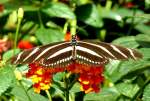
Exotic butterfly on 09.06.2008 in the butterfly house Wilhelma/Stuttgart
Manfred Möldner

Galleries / Animal photos / Insects and Spiders

1234 799x544 Px, 25.06.2008

Exotic butterfly on 09.06.2008 in the Wilhelma Butterfly House/Stuttgart
Manfred Möldner

Galleries / Animal photos / Insects and Spiders

775 800x542 Px, 25.06.2008

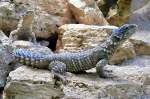
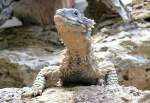
Blue Spiny Lizard on 09.06.2008 in Wilhelma/Stuttgart - The Blue Spiny Lizard (Sceloporus cyanogenys) from Texas and northeastern Mexico inhabits dry, rocky landscapes. Characteristic of this diurnal, agile climber is a rough scalation. All scales have a keel that ends in a small spine. With a length of up to 35 centimeters, it is the largest representative of its genus. Its diet includes spiders, insects, snails, and other invertebrates. The female gives birth to 4-18 young after a gestation period of 3-4 months. - Source = WIKIPEDIA
Manfred Möldner

Blue Spiny-tailed Iguana on 09.06.2008 in Wilhelma/Stuttgart
Manfred Möldner

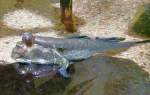
Mudskippers on 09.06.2008 in Wilhelma/Stuttgart - The true mudskippers (especially: Periophthalmus) inhabit the mangrove forests and the saltwater of tropical coasts (except America). They are active in feeding during high tide. Their distinctly thickened pectoral fins are arm-like and are used as  walking tools,  even to climb on roots and stones during low tide. Despite their reptilian lifestyle, their gill respiration and fins show that they are classified as fish. Only a narrow gill slit connects the gill chamber to the outside world, preventing the delicate respiratory organs from drying out. Through a freshwater reserve in the enlarged lung cavity and by gulping air, they can repeatedly refresh its oxygen content within limits. They have retained the goby shape, which already has some frog-like features, such as the rather immobile eyes protruding from the head. With their bulldozer-like heads, they sift through the silt layer for food particles and also graze algae underwater from their substrate. Because they can push off quickly from the ground with their straight tail, they received their name.

As a dwelling, on whose walls the females also lay their eggs, mudskippers build burrows in the silt of mangrove forests or river mouths on the shore, with up to four exits. Because the water in their habitats is usually very low in oxygen, the mudskipper repeatedly carries water in its mouth into the burrow to create a water reserve there.  
Their main predators, besides predatory fish, are herons and water snakes. - Source = WIKIPEDIA
Mudskippers on 09.06.2008 in Wilhelma/Stuttgart - The true mudskippers (especially: Periophthalmus) inhabit the mangrove forests and the saltwater of tropical coasts (except America). They are active in feeding during high tide. Their distinctly thickened pectoral fins are arm-like and are used as "walking tools," even to climb on roots and stones during low tide. Despite their reptilian lifestyle, their gill respiration and fins show that they are classified as fish. Only a narrow gill slit connects the gill chamber to the outside world, preventing the delicate respiratory organs from drying out. Through a freshwater reserve in the enlarged lung cavity and by gulping air, they can repeatedly refresh its oxygen content within limits. They have retained the goby shape, which already has some frog-like features, such as the rather immobile eyes protruding from the head. With their bulldozer-like heads, they sift through the silt layer for food particles and also graze algae underwater from their substrate. Because they can push off quickly from the ground with their straight tail, they received their name. As a dwelling, on whose walls the females also lay their eggs, mudskippers build burrows in the silt of mangrove forests or river mouths on the shore, with up to four exits. Because the water in their habitats is usually very low in oxygen, the mudskipper repeatedly carries water in its mouth into the burrow to create a water reserve there. Their main predators, besides predatory fish, are herons and water snakes. - Source = WIKIPEDIA
Manfred Möldner

Humboldt penguins on 09.06.2008 in Wilhelma/Stuttgart
Manfred Möldner

Exotic butterfly on 09.06.2008 in the Wilhelma Butterfly House/Stuttgart
Manfred Möldner

Galleries / Animal photos / Insects and Spiders

457 800x530 Px, 23.06.2008

Exotic butterfly on 09.06.2008 in the butterfly house Wilhelma/Stuttgart
Manfred Möldner

Galleries / Animal photos / Insects and Spiders

429 800x534 Px, 23.06.2008

Exotic butterfly on 09.06.2008 in the butterfly house Wilhelma/Stuttgart
Manfred Möldner

Galleries / Animal photos / Insects and Spiders

464 800x564 Px, 23.06.2008

Exotic butterfly on 09.06.2008 in the Wilhelma Butterfly House/Stuttgart
Manfred Möldner

Galleries / Animal photos / Insects and Spiders

432 800x562 Px, 23.06.2008

Exotic butterfly on 09.06.2008 in the butterfly house Wilhelma/Stuttgart
Manfred Möldner

Galleries / Animal photos / Insects and Spiders

406 800x518 Px, 23.06.2008

Exotic butterfly on 09.06.2008 in the Butterfly House Wilhelma/Stuttgart
Manfred Möldner

Galleries / Animal photos / Insects and Spiders

462 800x543 Px, 23.06.2008

Monarch - Butterfly on 09.06.2008 in the Butterfly House Wilhelma/Stuttgart
Manfred Möldner

Galleries / Animal photos / Insects and Spiders

456 800x494 Px, 23.06.2008

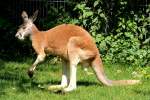
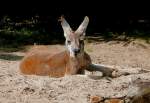
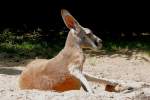
Red Kangaroo on 09.06.2008 in Wilhelma/Stuttgart - The Red Kangaroo (Macropus rufus) is a species of kangaroo. It is the largest representative of kangaroos and the largest living marsupial. Outstanding features of the giant kangaroos are the muscular hind legs and the strong tail, which can support the weight of the body alone. It is almost as long as the body and serves as support and balance during long jumps. The forelegs are comparatively short. The snout is elongated, the ears are long. The fur is short and coarse; in males, it is reddish-brown, while in most females it is bluish-gray. There are specimens where this is reversed.  
The Red Kangaroo reaches a head-body length of 0.9 to 1.6 m, with the tail being another 0.7 to 1.2 m long. When standing, they can reach a height of 1.8 m. Males are significantly larger than females; while males can weigh 55 kilograms (in some cases up to 90 kg), females rarely exceed 30 kg. -  
Distribution and habitat: These animals inhabit dry and semi-arid areas throughout Australia, except for the coasts and the southwest. They live in various habitats such as semi-deserts, steppes, and bushlands. However, they rarely stay in completely treeless areas, as they need trees for cover and protection from the hot sun. - Source = WIKIPEDIA
Red Kangaroo on 09.06.2008 in Wilhelma/Stuttgart - The Red Kangaroo (Macropus rufus) is a species of kangaroo. It is the largest representative of kangaroos and the largest living marsupial. Outstanding features of the giant kangaroos are the muscular hind legs and the strong tail, which can support the weight of the body alone. It is almost as long as the body and serves as support and balance during long jumps. The forelegs are comparatively short. The snout is elongated, the ears are long. The fur is short and coarse; in males, it is reddish-brown, while in most females it is bluish-gray. There are specimens where this is reversed. The Red Kangaroo reaches a head-body length of 0.9 to 1.6 m, with the tail being another 0.7 to 1.2 m long. When standing, they can reach a height of 1.8 m. Males are significantly larger than females; while males can weigh 55 kilograms (in some cases up to 90 kg), females rarely exceed 30 kg. - Distribution and habitat: These animals inhabit dry and semi-arid areas throughout Australia, except for the coasts and the southwest. They live in various habitats such as semi-deserts, steppes, and bushlands. However, they rarely stay in completely treeless areas, as they need trees for cover and protection from the hot sun. - Source = WIKIPEDIA
Manfred Möldner

Red Giant Kangaroo on 09.06.2008 in Wilhelma/Stuttgart
Manfred Möldner

Red Giant Kangaroo on 09.06.2008 in Wilhelma/Stuttgart
Manfred Möldner

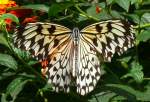
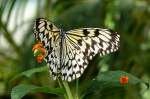
White Tree Nymph on 09.06.2008 in Wilhelma/Stuttgart - The White Tree Nymph (Idea leuconoe) is a butterfly (diurnal butterfly) from the family of brush-footed butterflies (Nymphalidae). The butterflies reach a wingspan of 95 to 115 millimeters. They have slightly transparent, white wings with black-colored wing veins. Additionally, they have black spots distributed on the wings, especially along the outer edge of the forewings. About in the middle of the leading edge of the forewings, there is a large black spot and further outward next to it a smaller one. The outer edge is broadly black-colored, with white spots visible within it. Their distribution area extends over Southeast Asia (Thailand, Malaysia, the Philippines, and Taiwan) and northern Australia. They are often kept in butterfly zoos, where they can live from 19 to 104 days. - Source = WIKIPEDIA
Manfred Möldner

Galleries / Animal photos / Insects and Spiders

463 800x549 Px, 22.06.2008

White Tree Nymph on 09.06.2008 in Wilhelma/Stuttgart
Manfred Möldner

Galleries / Animal photos / Insects and Spiders

408 800x533 Px, 22.06.2008

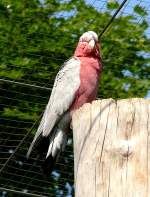
Rose-breasted Cockatoo on 09.06.2008 in Wilhelma/Stuttgart - The Rose-breasted Cockatoo (Eolophus roseicapilla, also called Galah in Australia) is a species of parrot native to Australia from the cockatoo family (Cacatuidae). - Description: With a body size of 35 cm, the Rose-crested Cockatoo (Eolophus roseicapillus) is one of the smallest but most colorful and the most widespread cockatoo species in Australia. Flocks numbering several thousand birds are not uncommon. And although the Galah, as it is called in Australia, is considered a pest and hunted in its homeland, it is a rare representative of its kind here due to the strict export regulations of the Australian government. The life expectancy is around 40 years, and their lifestyle is largely monogamous. - Lifestyle: They are distributed throughout Australia and inhabit both forests and open terrain, and can even be found in parks and gardens. Because they are adaptable, they are among the most common cockatoo species in the country. Their diet consists of seeds, grains, fruits, berries, and sometimes insects and their larvae. Since they sometimes move in large flocks, they are considered a pest in some areas because they can cause significant damage to fields and plantations. - Source = WIKIPEDIA
Manfred Möldner

Galleries / Animal photos / Birds, waterfowl

881 609x800 Px, 22.06.2008

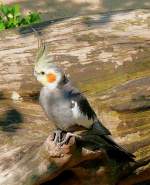
Cockatiel on 09.06.2008 in Wilhelma/Stuttgart - The cockatiel (Nymphicus hollandicus) is an Australian bird species from the order of parrots (Psittaciformes). It was previously unclear whether the cockatiel belonged to the cockatoos or the parakeets within the parrots (older names such as cockatoo parakeet and long-tailed cockatoo indicate these uncertainties in nomenclature), but it is now certain that it is classified among the cockatoos. - The birds, about 30 to 34 centimeters long, weigh approximately 90 to 110 grams. They live 15 to 20 years, in some cases up to 30 years. The original appearance of the cockatiel is gray with white wing coverts and an orange cheek patch. Males have a pronounced yellow facial mask, females have yellow-black barring on the underside of the tail. Unusual is the long pointed feather crest on the head, which the birds probably use to express sensations and moods. - Natural habitat and diet: Cockatiels live in the dry inland areas of Australia. They are currently not endangered there, but the existing wild population is considered to be declining. Except in closed forests, cockatiels can be found in almost every vegetation type of their habitat. The flocks live nomadically and roam extensive areas, only settling in one place during the breeding season. Typically, a flock consists of up to 50 individuals. During seasonal migrations, very large flocks form. At waterholes, over 1,000 birds have been observed simultaneously. Due to this constant mixing of the population, no recognizable subspecies have developed. Wild cockatiels feed on semi-ripe grasses and millets. Wheat and sorghum are also used. When foraging on the ground, one flock member (preferably a male) always remains perched on a high vantage point to warn of danger. - Source = WIKIPEDIA
Manfred Möldner

Galleries / Animal photos / Birds, waterfowl

701 647x800 Px, 22.06.2008