


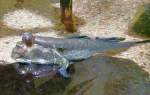
Mudskippers on 09.06.2008 in Wilhelma/Stuttgart - The true mudskippers (especially: Periophthalmus) inhabit the mangrove forests and the saltwater of tropical coasts (except America).
(ID 7198)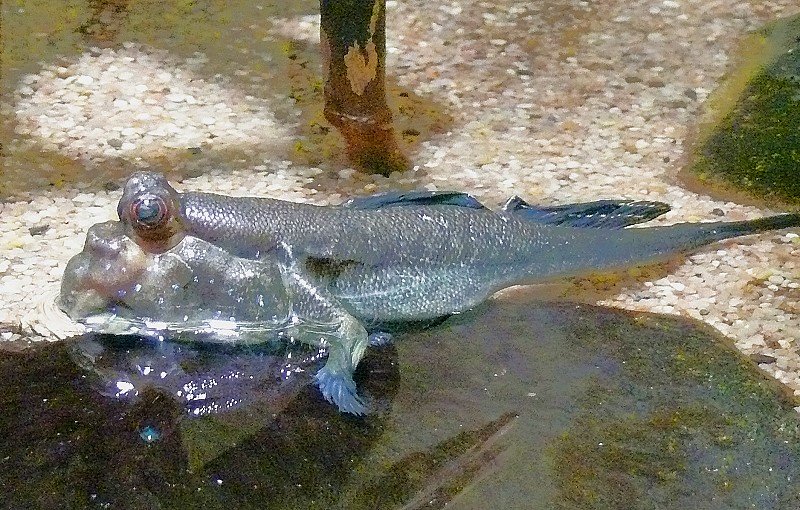
Mudskippers on 09.06.2008 in Wilhelma/Stuttgart - The true mudskippers (especially: Periophthalmus) inhabit the mangrove forests and the saltwater of tropical coasts (except America). They are active in feeding during high tide. Their distinctly thickened pectoral fins are arm-like and are used as "walking tools," even to climb on roots and stones during low tide. Despite their reptilian lifestyle, their gill respiration and fins show that they are classified as fish. Only a narrow gill slit connects the gill chamber to the outside world, preventing the delicate respiratory organs from drying out. Through a freshwater reserve in the enlarged lung cavity and by gulping air, they can repeatedly refresh its oxygen content within limits. They have retained the goby shape, which already has some frog-like features, such as the rather immobile eyes protruding from the head. With their bulldozer-like heads, they sift through the silt layer for food particles and also graze algae underwater from their substrate. Because they can push off quickly from the ground with their straight tail, they received their name.
As a dwelling, on whose walls the females also lay their eggs, mudskippers build burrows in the silt of mangrove forests or river mouths on the shore, with up to four exits. Because the water in their habitats is usually very low in oxygen, the mudskipper repeatedly carries water in its mouth into the burrow to create a water reserve there.
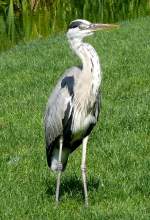
Their main predators, besides predatory fish, are herons and water snakes. - Source = WIKIPEDIA
Manfred Möldner http://www.railpix-ch.de/ 25.06.2008, 1449 Views, 0 Comments * automatically translated

785 800x561 Px, 23.09.2009
2354 800x552 Px, 22.08.2009
1247 800x608 Px, 22.08.2009
867 800x516 Px, 31.03.2009