
landschaftsfotos.eu Linie landschaftsfotos.eu
Hello guest, you are not logged in. Log in | Create account 
Forum   Contact   Legal notice
German English 

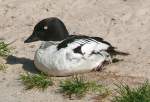
Common Goldeneye on 09.06.2008 in Wilhelma/Stuttgart - The Common Goldeneye (Bucephala clangula) is a bird species from the duck family (Anatidae).

(ID 7107)
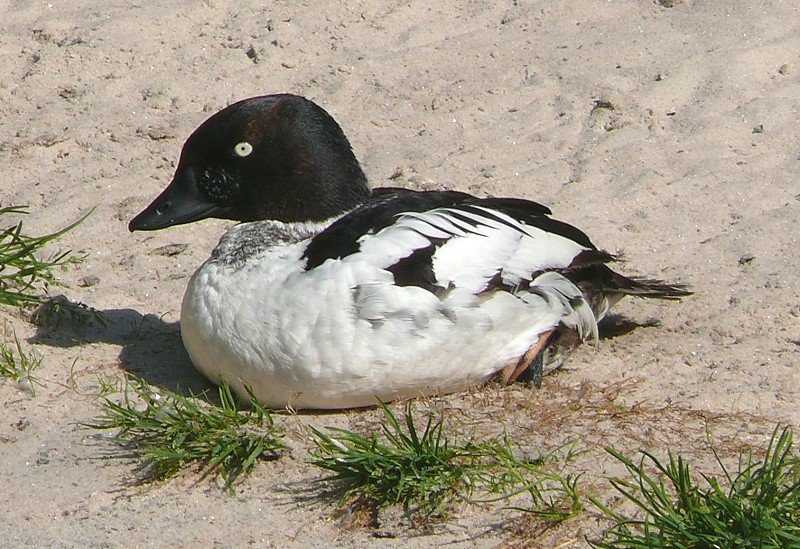

Common Goldeneye on 09.06.2008 in Wilhelma/Stuttgart - The Common Goldeneye (Bucephala clangula) is a bird species from the duck family (Anatidae). The 45 to 50 cm large Common Goldeneye weighs 500 to 1300 g and reaches a wingspan of up to 80 cm. What first catches the eye are the bright yellow eyes, which are also the reason for the English name  Goldeneye.  The Common Goldeneye can live up to 17 years and its call sounds roughly like  rr  or  grar.  The male has black and white plumage and a dark green head. Between the eye and the black bill, there is a white spot. The female has gray plumage and a dark brown head without a white spot. The legs are reddish colored. The American subspecies Bucephala clangula americana is somewhat larger than the European nominate form B. c. clangula. - Habitat: The Common Goldeneye lives in Eastern, Central, and Northern Europe, in Asia, and North America. It feels very comfortable in standing waters such as lakes and ponds. Originally, it was a characteristic species for nutrient-poor, oligotrophic waters. Today, in Central Europe, the Common Goldeneye also inhabits nutrient-rich, polytrophic waters. It can also be found in slow-flowing waters and along the coast. - Diet: The Common Goldeneye feeds on snails, crustaceans, plant parts, small fish, insects, and their larvae. It can dive up to eight meters deep to catch its meals. - Source = WIKIPEDIA

Common Goldeneye on 09.06.2008 in Wilhelma/Stuttgart - The Common Goldeneye (Bucephala clangula) is a bird species from the duck family (Anatidae). The 45 to 50 cm large Common Goldeneye weighs 500 to 1300 g and reaches a wingspan of up to 80 cm. What first catches the eye are the bright yellow eyes, which are also the reason for the English name "Goldeneye." The Common Goldeneye can live up to 17 years and its call sounds roughly like "rr" or "grar." The male has black and white plumage and a dark green head. Between the eye and the black bill, there is a white spot. The female has gray plumage and a dark brown head without a white spot. The legs are reddish colored. The American subspecies Bucephala clangula americana is somewhat larger than the European nominate form B. c. clangula. - Habitat: The Common Goldeneye lives in Eastern, Central, and Northern Europe, in Asia, and North America. It feels very comfortable in standing waters such as lakes and ponds. Originally, it was a characteristic species for nutrient-poor, oligotrophic waters. Today, in Central Europe, the Common Goldeneye also inhabits nutrient-rich, polytrophic waters. It can also be found in slow-flowing waters and along the coast. - Diet: The Common Goldeneye feeds on snails, crustaceans, plant parts, small fish, insects, and their larvae. It can dive up to eight meters deep to catch its meals. - Source = WIKIPEDIA

Manfred Möldner http://www.railpix-ch.de/ 22.06.2008, 516 Views, 0 Comments * automatically translated
0 Comments, All comments
Nesting burrows of sand martins on the west shore of Poel Island. - 10.07.2015
Gerd Wiese

Three seagulls are apparently enjoying the stormy Szczecin Lagoon at Ueckerkopf. - 22.07.2014
Gerd Wiese

After the harvest, a buzzard apparently uses the straw bale as a hunting perch. - 22.07.2014
Gerd Wiese

A birdhouse for nesting on the trunk of a linden tree. The photo was taken on 16.2.2012 near Brixlegg.
Markus

Galerien / Tierfotos / V�, Wasserv�

647 575x1024 Px, 16.02.2012