
landschaftsfotos.eu Linie landschaftsfotos.eu
Hello guest, you are not logged in. Log in | Create account 
Forum   Contact   Legal notice
German English 

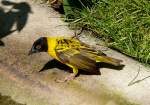
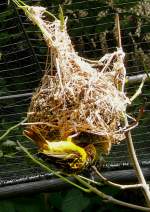
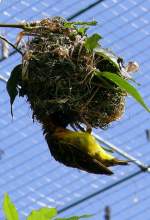
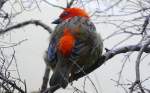
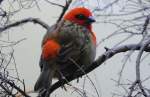
Village weaver on 09.06.2008 in Wilhelma/Stuttgart.

(ID 7102)
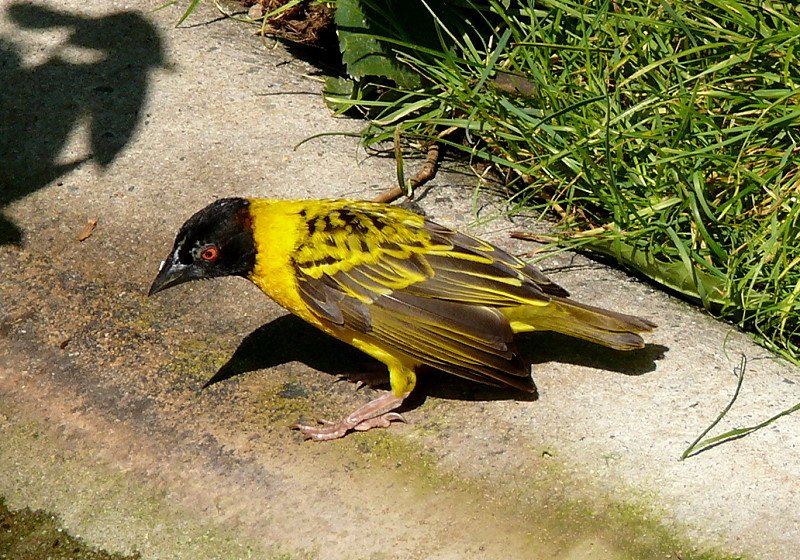

Village weaver on 09.06.2008 in Wilhelma/Stuttgart. The village weaver, also known as the village weaverbird (Ploceus cucullatus), is a species from the weaverbird family. It was previously classified in the genus Textor and was then called Textor cucullatus. - The village weaver reaches a body length of 15 to 18 centimeters. During the breeding season, the males display bright yellow plumage. The head and wings, however, are covered with black feathers. Outside the breeding season, the males' plumage resembles that of the females. It is then greenish in color with fine streaking. - Behavior: Village weavers are lively and noisy colonial breeders that build their kidney-shaped hanging nests from grass close together. During nest building, males can often be observed hanging upside down on branches with fluttering wings. Incubation of the eggs and raising of the young birds is mainly done by the females. - Distribution and habitat: Village weavers are found from Sudan and southern Ethiopia to Angola and the Cape Province of South Africa. Within this range, they inhabit the edges of forests as well as agricultural areas and village environments. - Source = WIKIPEDIA

Village weaver on 09.06.2008 in Wilhelma/Stuttgart. The village weaver, also known as the village weaverbird (Ploceus cucullatus), is a species from the weaverbird family. It was previously classified in the genus Textor and was then called Textor cucullatus. - The village weaver reaches a body length of 15 to 18 centimeters. During the breeding season, the males display bright yellow plumage. The head and wings, however, are covered with black feathers. Outside the breeding season, the males' plumage resembles that of the females. It is then greenish in color with fine streaking. - Behavior: Village weavers are lively and noisy colonial breeders that build their kidney-shaped hanging nests from grass close together. During nest building, males can often be observed hanging upside down on branches with fluttering wings. Incubation of the eggs and raising of the young birds is mainly done by the females. - Distribution and habitat: Village weavers are found from Sudan and southern Ethiopia to Angola and the Cape Province of South Africa. Within this range, they inhabit the edges of forests as well as agricultural areas and village environments. - Source = WIKIPEDIA

Manfred Möldner http://www.railpix-ch.de/ 22.06.2008, 818 Views, 0 Comments * automatically translated


0 Comments, All comments
Nesting burrows of sand martins on the west shore of Poel Island. - 10.07.2015
Gerd Wiese

Three seagulls are apparently enjoying the stormy Szczecin Lagoon at Ueckerkopf. - 22.07.2014
Gerd Wiese

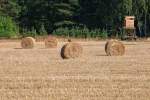
After the harvest, a buzzard apparently uses the straw bale as a hunting perch. - 22.07.2014
Gerd Wiese

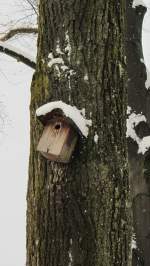
A birdhouse for nesting on the trunk of a linden tree. The photo was taken on 16.2.2012 near Brixlegg.
Markus

Galerien / Tierfotos / V�, Wasserv�

647 575x1024 Px, 16.02.2012