
landschaftsfotos.eu Linie landschaftsfotos.eu
Hello guest, you are not logged in. Log in | Create account 
Forum   Contact   Legal notice
German English 

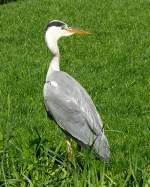
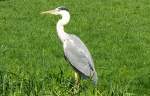
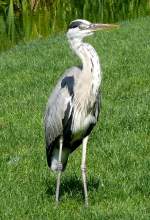
Grey Heron on 09.06.2008 in Wilhelma/Stuttgart - The Grey Heron (Ardea cinerea), also called the Fish Heron, is a bird species from the order of wading birds (Ciconiiformes) - Distribution: It is

(ID 7105)
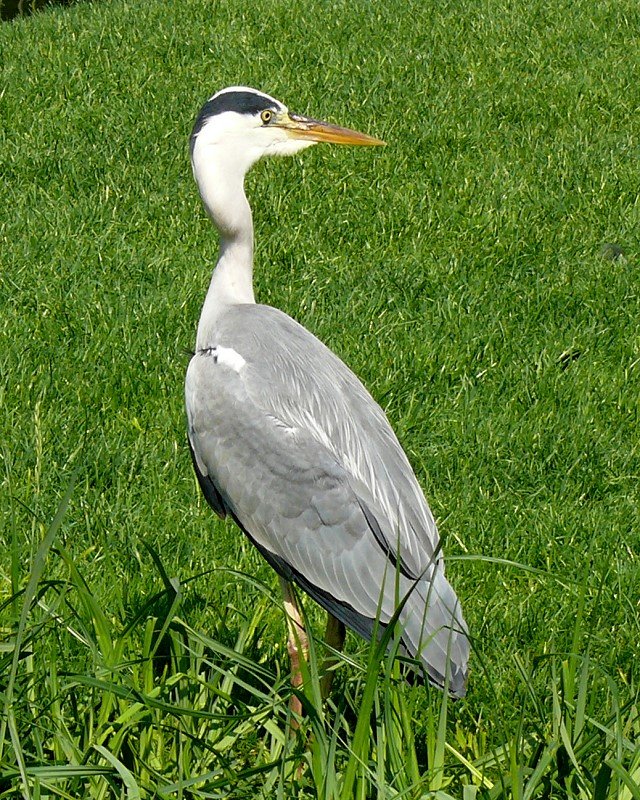

Grey Heron on 09.06.2008 in Wilhelma/Stuttgart - The Grey Heron (Ardea cinerea), also called the Fish Heron, is a bird species from the order of wading birds (Ciconiiformes) - Distribution: It is found in the milder regions of Europe and Asia, as well as throughout southern Africa except for the southern coasts. In predominantly ice-free regions, it is a resident bird, while in other areas it migrates further south in winter. In Germany, it is mostly a resident bird. In severe winters, when many open water surfaces freeze over, population losses are very high. The Grey Heron particularly prefers shallow, overgrown small ponds and pools that are preferably bushy and wooded around. Recently, it has increasingly moved into urban areas, where it can now often be observed even in city centers. It also forms mixed groups with Little Egrets (for example in the Po Valley in northern Italy) - Appearance: The Grey Heron is somewhat smaller than a stork (about 90 cm). The plumage on the forehead and crown is white, the neck is grey-white, and the back is ash grey with white bands. It has black eye stripes as well as three long black crest feathers forming a plume, a triple row of black spots on the front of the neck, and black wings. It flies with slow wing beats and head pulled back to the shoulders, with an s-shaped curved neck. During flight, a loud, rough  chräik  call is regularly heard. The Grey Heron reaches a wingspan of about 1.70 m. - Source = WIKIPEDIA

Grey Heron on 09.06.2008 in Wilhelma/Stuttgart - The Grey Heron (Ardea cinerea), also called the Fish Heron, is a bird species from the order of wading birds (Ciconiiformes) - Distribution: It is found in the milder regions of Europe and Asia, as well as throughout southern Africa except for the southern coasts. In predominantly ice-free regions, it is a resident bird, while in other areas it migrates further south in winter. In Germany, it is mostly a resident bird. In severe winters, when many open water surfaces freeze over, population losses are very high. The Grey Heron particularly prefers shallow, overgrown small ponds and pools that are preferably bushy and wooded around. Recently, it has increasingly moved into urban areas, where it can now often be observed even in city centers. It also forms mixed groups with Little Egrets (for example in the Po Valley in northern Italy) - Appearance: The Grey Heron is somewhat smaller than a stork (about 90 cm). The plumage on the forehead and crown is white, the neck is grey-white, and the back is ash grey with white bands. It has black eye stripes as well as three long black crest feathers forming a plume, a triple row of black spots on the front of the neck, and black wings. It flies with slow wing beats and head pulled back to the shoulders, with an s-shaped curved neck. During flight, a loud, rough "chräik" call is regularly heard. The Grey Heron reaches a wingspan of about 1.70 m. - Source = WIKIPEDIA

Manfred Möldner http://www.railpix-ch.de/ 22.06.2008, 547 Views, 0 Comments * automatically translated
0 Comments, All comments
Nesting burrows of sand martins on the west shore of Poel Island. - 10.07.2015
Gerd Wiese

Three seagulls are apparently enjoying the stormy Szczecin Lagoon at Ueckerkopf. - 22.07.2014
Gerd Wiese

After the harvest, a buzzard apparently uses the straw bale as a hunting perch. - 22.07.2014
Gerd Wiese

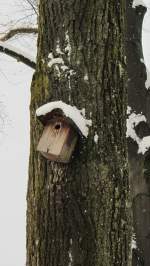
A birdhouse for nesting on the trunk of a linden tree. The photo was taken on 16.2.2012 near Brixlegg.
Markus

Galerien / Tierfotos / V�, Wasserv�

648 575x1024 Px, 16.02.2012